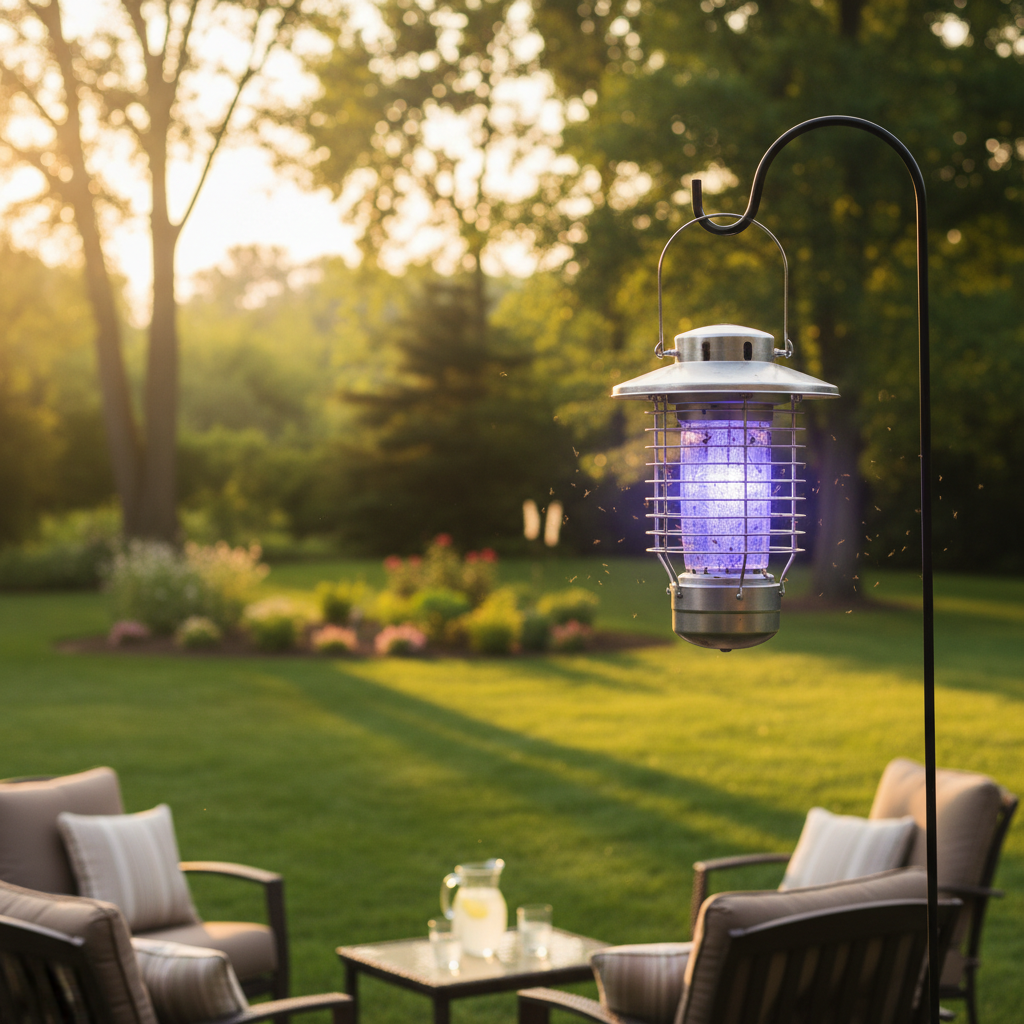
Have you ever wondered why certain light sources seem to act like magnets for insects, especially on a warm evening? It’s a common sight: moths fluttering frantically around streetlights, tiny gnats swarming porch lamps. This phenomenon is more than just a nuisance; it’s a fascinating display of insect biology and physics in action, primarily driven by their unique visual perception of blue and ultraviolet (UV) light. Understanding the science behind this attraction can shed light on how we design our outdoor spaces and even control pests.
Understanding Insect Vision: A Different Spectrum
The key to understanding why insects are drawn to blue light lies in how they perceive the world around them. Unlike humans, whose eyes typically have a single lens, most insects possess compound eyes. These intricate visual organs are made up of thousands of tiny light-sensing units called ommatidia, each functioning as a miniature eye. This complex structure grants insects an exceptionally wide field of view, creating a mosaic-like image of their environment and making them highly sensitive to motion.
Crucially, the range of colors insects can see differs significantly from our own. While humans perceive a spectrum from red to violet, many insects cannot see red light at all. Instead, their vision extends into the ultraviolet (UV) spectrum—wavelengths invisible to the human eye. Most insects have photoreceptors tuned to shorter wavelengths, making blue, violet, and UV light particularly prominent in their visual world. Some insects have trichromatic vision, similar to humans, but with peaks in UV, blue-violet, and yellow, enabling them to perceive a complete spectrum within their sensitivity. Others are bichromatic, with receptors for green/yellow and blue/UV, which offers a different color perception. This ability to detect UV light is vital for their survival, guiding them to food sources like flowers, which often display intricate UV patterns that are hidden to us.
The Phenomenon of Phototaxis and Optical Illusions
The attraction of insects to light is largely explained by a behavioral response known as phototaxis – an innate movement towards or away from a light source. For many nocturnal flying insects, this response has a deep evolutionary root.
Celestial Navigation Gone Awry
|
Our Picks for the Best Mosquito killer lamp in 2026
As an Amazon Associate I earn from qualifying purchases.
|
||
| Num | Product | Action |
|---|---|---|
| 1 | ASPECTEK Insect Killer, Bug Zapper, Powerful 20W Electronic Indoor Fly Zapper for Mosquito, Fungus Gnat, Asian Beetle, Moth, Flying Pests - Indoor Use, Includes 2-Pack Replacement Bulbs |

|
| 2 | Bug Zapper Light Bulb, 2 in 1 Mosquitoes Killer Lamp Led Electronic Insect & Fly Killer, Porch Light for Entryway, Doorway, Corridor, Balcony and Patio (White) |
|
| 3 | YISSVIC Bug Zapper Outdoor Indoor Waterproof Electric Mosquito Lamp Fly Zapper Killer Effective 4200V Plug in for Home Patio Office Courtyard |
|
| 4 | YISSVIC Bug Zapper Outdoor Indoor Waterproof Electric Mosquito Lamp Fly Zapper Killer Effective 4200V Plug in for Home Patio Office Courtyard (One-Light Control Bug Zapper) |
|
| 5 | GOOTOP Bug Zapper Outdoor, Mosquito Zapper, 3 Prong Plug in Electric Fly Zapper, Mosquito Killer, Fly Traps, Flying Insects Zapper Indoor Outdoor, 4200V, ABS Plastic Outer (Black) |
|
| 6 | Buzbug 50,000 Hrs Lifespan LED Bug Zapper Indoor, 3800V High-Voltage Indoor Fly Trap, 3 LED Bulbs Enhanced Dual-Band Attraction & Energy Saving, Electric Mosquito Killer for Gnats, Fruit Flies, Moths |
|
| 7 | Bug Zapper Outdoor Indoor, Mosquito Zapper, Electric Fly Traps IPX4 Waterproof 20W Lamp Fly Insects Traps for Patio, Garage, Backyard, Porch |
|
| 8 | Electric Bug Zapper Indoor/Outdoor, 4200V High Powered Mosquito Zappers Killer, Waterproof Insect Fly Swatter Zapper Mosquito Trap Outdoor, Fly Traps, Insect Killer for Home,Garden,Backyard, Camping |
|
| 9 | Electric Bug Zapper Indoor, Mosquito Zapper with 3500V Powerful Dual Grid & Remote, Fly Zapper Fly Trap Insect Killer for Patio Yard Home Kitchen Camping - Including 2 Replacement Bulbs (Black) |
|
| 10 | LUOJIBIE Bug Zapper Outdoor, Electric Mosquito Killer Fly Trap with UV/LED Light, 4200V High Voltage Waterproof Flying Insect Zapper for Backyard Patio, Indoor Mosquito Zapper for Home Garage |
|
For millions of years, insects have relied on natural, distant light sources like the sun and moon for navigation. These celestial bodies are so far away that their light rays arrive effectively parallel. Insects evolved to use a sophisticated navigation technique called transverse orientation, where they maintain a constant angle to these distant light sources to fly in a straight line. The moon, for instance, serves as a natural compass point in the night sky.
The Dorsal Light Response Explained
When an artificial light source, such as a porch light or a streetlamp, is introduced into the environment, this ancient navigational system goes awry. Unlike the sun or moon, an artificial light is a nearby, point-source light. If an insect tries to maintain a constant angle to this close light source, its flight path inevitably becomes a spiral, drawing it closer and closer to the bulb. This involuntary spiraling toward artificial lights is often referred to as the “dorsal light response” or a navigational mistake, as the insect’s instinct to orient itself by light ends up trapping it.
Mimicry of Natural Cues
Beyond mere navigational confusion, blue and UV light wavelengths can also mimic natural cues that are significant to insects. Many flowers, for example, reflect ultraviolet light, creating patterns that act as “nectar guides” for pollinators like bees. To an insect, a strong UV or blue light source might therefore resemble a beacon to a potential food source. Similarly, the blue hues of artificial light can be mistaken for the natural blue light of the sky, which insects use to determine “up” or “down,” further contributing to their disorientation and attraction.
Blue Light vs. Ultraviolet (UV) Light: A Spectrum of Attraction
When we talk about light attracting insects, both blue light and ultraviolet (UV) light play significant roles, though they occupy slightly different segments of the electromagnetic spectrum. Blue light typically refers to visible light with wavelengths ranging from approximately 450 to 500 nanometers (nm). UV light, on the other hand, consists of shorter wavelengths, generally below 400 nm, and is invisible to humans. Within the UV spectrum, UVA (315-400 nm) is particularly relevant to insect attraction.
Many common flying insects, including moths, beetles, house flies, and gnats, are highly sensitive to both blue and UV wavelengths. Their photoreceptors are specifically tuned to these shorter wavelengths, making them exceptionally visible and compelling. This is precisely why devices like bug zappers are designed to emit blue or UV light; they strategically leverage this natural attraction to lure and eliminate pests. The efficacy of specific UV wavelengths is well-documented, with many studies showing that ranges between 310 nm and 370 nm are particularly attractive to house flies, for example. The combined effect of blue and UV light creates a powerful draw that is difficult for these insects to resist.
The Unique Case of Mosquitoes: More Than Just Light
While many insects are undeniably drawn to blue and UV light, mosquitoes present a more complex picture. Contrary to popular belief, mosquitoes are not primarily attracted to light. Their main method for locating hosts is through a combination of sensory cues, with carbon dioxide (CO2), body heat, and specific body odors being the most significant attractants. Female mosquitoes, who are the ones that bite, can detect CO2 from impressive distances, signaling the presence of a potential blood meal.
Mosquitoes can see blue and green light (wavelengths around 450-570 nm) and may exhibit a mild attraction to them. However, UV light itself is generally not a strong attractant for most mosquito species when compared to moths or gnats. While some studies, particularly in specific settings like forests, have shown that UV fluorescent light can be effective for trapping certain Anopheles mosquito species, this is not a universal rule. Interestingly, research suggests that after detecting CO2, mosquitoes may show a preference for red and orange hues. This is because human skin tones register as a strong red-orange color to their eyes, guiding them to their targets. Therefore, while blue light might play a minor role, it is usually overshadowed by the more potent chemical and thermal cues that mosquitoes rely on.
Practical Applications: Harnessing or Mitigating Insect Attraction
The scientific understanding of how insects respond to different light wavelengths has practical implications for both pest control and everyday living.
Designing Insect-Friendly Outdoor Spaces
If you aim to minimize insect activity around your outdoor areas, the color temperature of your lighting is a critical consideration. Warmer-toned lights, such as yellow, amber, or red, emit longer wavelengths that are far less visible and attractive to most insects. Switching to these colors for porch lights, patio lights, and garden illumination can significantly reduce the number of bugs congregating in your space, leading to a more comfortable environment. Some modern LED lights even offer adjustable color temperatures, allowing users to fine-tune their outdoor ambiance while keeping pests at bay.
Strategic Lighting for Pest Control
Conversely, the strong attraction of many insects to blue and UV light is intentionally exploited in various pest control technologies. Insect traps, including electric bug zappers and sticky light traps, are specifically designed to emit these attractive wavelengths. By strategically placing these devices away from human activity zones, they can effectively lure and capture target pests like moths, flies, and beetles, thus reducing their presence elsewhere. Research has even explored advanced techniques, such as using blue LED lights to improve the trapping efficiency for specific agricultural pests like the fall armyworm moth.
Choosing the Right Bulbs
When selecting light bulbs for your home, especially for outdoor use, consider the spectral output. Many “cool white” or daylight-spectrum LED bulbs emit a significant amount of blue light, which can inadvertently increase insect attraction. Opting for “warm white” or “soft white” LEDs, which have a lower blue light content and higher yellow/red output, can be a simple yet effective strategy to mitigate unwanted insect activity around your home.
Expert Perspectives on Light Pollution and Insects
The proliferation of artificial light at night (ALAN), particularly those rich in blue and UV wavelengths, has significant ecological consequences, impacting insect populations globally.
“The instinct that evolved to help insects navigate by natural light sources like the moon and stars is fundamentally disrupted by the prevalence of artificial lights. This causes what we call an ‘ecological trap,’ where insects are drawn to lights, expending energy, becoming disoriented, and often dying, impacting entire ecosystems.”
This disruption not only affects individual insects but can also have broader ecological impacts, interfering with pollination, predator-prey dynamics, and even insect migration patterns.
Conclusion
The science behind why blue light attracts insects is rooted in their evolutionary history and unique visual systems. Their compound eyes are highly sensitive to shorter wavelengths, including blue and ultraviolet light, which they historically used for navigation and to locate food sources. However, the advent of artificial lighting has transformed these essential cues into disorienting traps, drawing many species to their demise. While mosquitoes exhibit a more nuanced attraction, prioritizing chemical and thermal cues, most other flying insects find blue and UV light overwhelmingly irresistible. By understanding these scientific principles, we can make informed decisions about our lighting choices, creating environments that are both comfortable for humans and less disruptive to the natural world.
Frequently Asked Questions
What specific wavelengths of light attract insects?
Insects are primarily attracted to shorter wavelengths of light, specifically those in the blue (around 450-500 nm) and ultraviolet (UV, below 400 nm, especially UVA 315-400 nm) spectrums. These wavelengths are most visible to their compound eyes and mimic natural cues.
Do all insects react to blue light in the same way?
No, not all insects react to blue light identically. While many flying insects like moths, flies, and beetles are strongly attracted, others like mosquitoes have a milder attraction to blue and UV light, primarily relying on other cues such as carbon dioxide and body heat.
Can yellow or amber lights deter insects?
Yellow and amber lights, which have longer wavelengths and contain very little blue or UV light, are generally less attractive to most insects. While they don’t actively “repel” bugs, using them for outdoor lighting can significantly reduce the number of insects drawn to an area compared to blue or white lights.
Why do bug zappers use blue or UV light?
Bug zappers utilize blue or UV light because these wavelengths fall within the most sensitive part of many insects’ visual spectrum. This strong visual attraction serves as an effective lure, drawing insects into the device where they are then eliminated.
How does artificial light at night impact insect populations?
Artificial light at night (ALAN), especially blue-rich light, can significantly disrupt insect behavior. It disorients insects that rely on celestial navigation, leading to exhaustion, increased predation risk, and impaired reproduction. This light pollution can contribute to declines in insect populations, affecting entire ecosystems.